The future circular economy in Kentucky
Capital, energy (as in zheng nengliang), physical energy (electricity), and financial investment are all being sucked into the AI bubble. But almost five million Kentuckians live in the real economy, with expensive electricity, a refrigerator that's about to go, a brand-new this year phone with an already broken screen, and a snowblower it turns out they didn't need.
Secondary markets
Thus there's a thriving secondary market for durable consumer goods. You can buy used children's clothes and toys at shops in every town, including the incomparable Once Upon a Child in Paducah.
Junkyards sell parts out of cars. There are a few in most counties. "Auto recycler" used parts stores strip cars for parts, shelve them, and inventory them, to make it easier to find what you're looking for in person, by phone, or online.
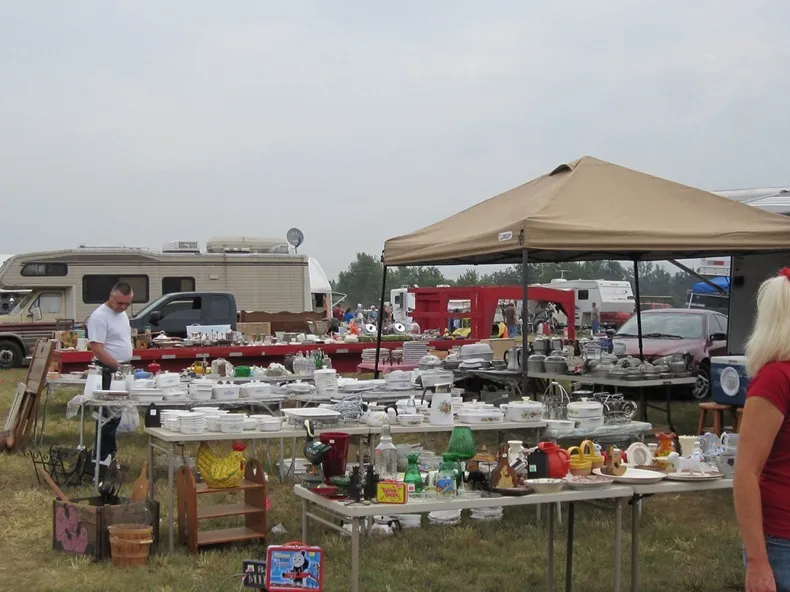
Most counties have at least one thrift shop: Goodwill, St. Vincent de Paul, Christian Appalachian Project. For each thrift store there are a dozen flea markets and "antique malls," indoor yardsales with rented vendor stalls.
The "world's longest yard sale" runs from Addison, Michigan to Gadsden, Alabama, right through central Kentucky. There are people outside its route who hold periodic yard sales, or keep their yard sale up year-round.
Online, people buy and sell almost everything on Facebook marketplace. On the air, many radio stations run all-morning call-in swap meets (I'm in the listening area for at least two). Callers buy and sell tires, firearms, junk-hauling services, firewood, housekeeping services, furniture, vehicles, and anything else you can imagine.
This vast constellation of secondary markets doesn't count non-local resellers who sell used items through ebay, Amazon, and tiktok. Many local sellers put high-value and low-weight items on e-commerce platforms and mail them to buyers.
Problems
The secondary market presents two difficulties for prospective buyers. First, it's dispersed. You can go to the Wal-mart and spend all your money in one place for everything from groceries to a water pump for your car. Second, it's a crapshoot. To find something specific in the secondary market, you have to look everywhere, know a lot of people, be very patient, and often settle for a substitute.
Common and rare stuff
A more physically accessible market for frequent or common items, and a better-managed and integrated inventory of rare and hard-to-find items will vastly increase the utility of the secondary market. As more people turn to it for regular shopping, it needs to recapture more durable goods from disposal and recirculate them.
The centralization of common items begins with an expansion of farmers' markets and other municipal supported markets to include non-food items. Agriculture Extension offices or something similar under the Small Business Association helps sellers with data and educational materials on commonly-purchased secondhand goods, so market-day sellers focus their inventories on stuff that's worth toting because it will move.
More people will buy at municipally-supported markets. Market days will become a social occasion as well as a shopping occasion for a greater proportion of the population. People who lose work in the formal economy can shift to collecting, storing, fixing, inventorying, transporting, or selling in the thriving secondary market.
Inventory management for rare and hard-to-find items is the second issue. This is especially important for people engaged in maintenance and repair, jobs that increase in importance with stronger and more integrated secondary markets, with a higher volume of durable goods flowing through them.
County and municipal experiments, in collaboration with land-grant universities, private colleges, and community college systems will develop a variety of local item registries, or shared, searchable databases. Many of these will be merged during a pretty excruciating process to allow easier statewide searches for items too rare to find locally. Some counties or regions will refuse to join the statewide network. Their local networks will battle scrapers.
Access to this system will be by internet searches, or by calling or visiting brokers who search for you and take a small cut of any sales for their service.
The repair market
Finally, the repair market will grow, for aging durable goods from washing machines to cellphones, and new durable goods beginning to be produced by new local light industries.
During severe economic downturns, people will scavenge back lots and waste dumps for recoverable, repairable objects. Along the way, innovations will be made, as objects are not only repaired, but modified into new forms, with new capabilities fitted to what we have and what we need.
Centralizing markets for everyday things, organizing markets for rare things, and growing repair and salvage sectors will rationalize the circular economy.
This story is released into the public domain. It is only as true as you make it.